Sunday, March 6, 2016

Tomato Time 2016

We moved last year.  And we knew we were moving before it was even time to plant tomato seeds.  So I took a year off - entirely off from starting seeds, and mostly off for the garden.  Only planted a couple of things and the size of the garden was much smaller.  For 8 summers I first tried, and then succeeded in growing tomatoes from seed.  It's tricky.  But not that hard.  As long as you have the right light for it.

I used to have a beautiful, south-facing room with six side-by side large windows - two on the west and 4 on the south.  It was amazing for starting tomatoes.

Now things are different.  I have a south facing window - but only two side by side and some big trees in front of the windows.  So we are going to see how this goes.  Might be a bit of an experiment.  But I'll keep you posted, and I can always buy a few seedlings at the nursery.   At least this time I don't have to have my greenhouse in my tiny office.  It's now in our spare bedroom (that's a Murphy bed in the photo.  It's fantastic!!)

Just a reminder, though, if you are starting seeds for tomatoes or peppers, now is the time.


Monday, October 26, 2015

Garlic

About 4 years ago a friend of mine who owns an organic farm on Salt Spring Island in British Columbia, gave me a head of garlic with 4 cloves in it.  It was April and I planted them in a large pot when I got home.

I saved most of the garlic that grew from those first 4 cloves so that I would have lots the following year.  Last year I think I grew something around 50 or 60 heads of garlic.

This past summer, we had our house up for sale and were moving, I planted a lot fewer garlic cloves  (maybe 18) late at the house we were moving into - friends owned it, so they let me plant before we moved in, but it was much later than I normally would plant garlic.

So, last week, with about 5 heads of garlic still left from last summer, and with the heads I grew this year not quite mature, I decided to Fall plant the old ones and see what happens.  The ground here is much wetter than at the old house, so I hope they don't rot over the winter, but we'll see what happens.  I planted them about 10cm deep and have covered them with leaves and straw.

I do have a few heads that will be usable next spring, so we'll see which works better - the Fall or Spring planted.

No photo today, sorry, no time.

Next year will be experimental with a new garden space, less light, north back yard, not south.  Probably more planters that can be moved to sunnier patches.  But hopefully more blog posts!

Sunday, June 28, 2015

Missing ....

The blog has been quiet this year - very quiet.  I apologize for that.

Early in the year I decided that I didn't need to start any tomatoes.  I have more canned tomatoes in the basement than I will use this year and next, so I didn't see the point in having 40+ plants this year.

I had a few potatoes in the basement with really long runners and a few onions had sprouted, so I planted them, but that was very early in the year - March.  I figured if they didn't grow, it would be no worse than composting them.

And then something came up.  Friends of ours were selling their house and we decided to buy it from them.  Putting a garden in that I would have to abandon half way through the summer seemed really silly.  I have also been working more than usual, so not having the garden seemed like taking a well-deserved break.

Someone asked me the other day if I missed having the garden.  And I didn't, really.  No weeding, no planting, no watering or worrying about drought.

And then tonight ... I pulled out one of those onions and seven beautiful new potatoes with delicate skins and cut them up along with some of last year's garlic and they are frying in the pan.  And now I know why I garden.  I miss the peas and the carrots fresh out of the garden, and the lettuce (which I could have planted and should have ....).

So I am now going to have to get really creative with our new south-facing house with tons of huge trees around it.  There is no obvious garden spot for vegetables (although there is a beautiful flower garden and some fruit trees).  So maybe the blog will take on a new theme - gardening in strange spaces in the north.

Sunday, July 27, 2014

Eat from the garden for August

Okay, I'm going to try something this summer.  I'm going to try and get my family to only eat the veggies and fruit that we either already have in the house or that we get from the garden or a local U-Pick.  I don't want to buy any fruits or vegetables from the store.  We have this amazing garden, so why not use it all?

I'm not entirely sure how my two men will deal with that as we will have to eat a lot of zucchini and peas, but I'm going to implement this experiment.

Wish us luck!

Not sure when I took this one, but earlier than the one below

July 18, 2014

Friday, July 18, 2014

Tomatoes - pruning and care.

I've been growing tomatoes for the past 15 years or so.  I started off with tomato plants on my balcony in an apartment, and now I'm lucky enough to own my own house and have a large yard with a big garden.  Tomatoes always make up a big portion of it.  I think the most plants I ever grew was around 80.  I'm down to about 1/2 of that now.  I still have canned tomatoes from 2012 and 2013, so I need to tone it down.  

People tell me that tomatoes can be tricky - and I've certainly had my bad experiences with them (one year I had 200lbs of tomatoes melt in my basement from blight!).  But in general, with a few basics, tomatoes are pretty easy and well worth any effort.  Have you eaten a tomato from the grocery store lately?  Or on a hamburger - you know, the mealy pink ones?  They are gross.  And not what a tomato should be like.  So the real ones are totally worth it.

1) GROWING FROM SEED:  I grow my heirlooms from seed, and this year I grew a lot of them from seed I saved from last year.  I started them inside in March.  I have a bright south-facing room and a small greenhouse that fits in a window.  That combination works well.  The first year I tried, though, I didn't have the greenhouse and all I got was long, stringy tomato plants that were so weak I had to throw them out.  Failure = Learning.  

2) PLANTING:  You plant them after the last frost - and after you've hardened them off - tomatoes don't like going from nice warm greenhouse to cool, sunny, breezy out-of-doors.  So you give them short exposures for a few days until they get used to it.  Kinda like you give yourself short bursts of sun before spending hours out there.

3) CALCIUM:  But after frost and hardening off, they go in the ground.  Tomatoes like calcium - or they get blossom end rot.  It doesn't completely ruin your fruit, but it's not pleasant.  I have been collecting all of my egg shells, grinding them with my mortar and pestle, and sprinkling them on the ground around the plants this year.  I'll let you know how it works.  Bone meal is also good, and one year I planted each of my tomatoes with a calcium tablet (not sure if that worked or not, but I haven't had blossom end rot for a while).

4) WATER:  Tomatoes require water and heat.  They liked to be watered at regular intervals - every second day or so if they are in the ground, every day if you have them in planters.  Uneven watering leads to cracked fruit, dead fruit, or (again) blossom end rot.  So water them regularly.  We've had some long hot stretches this year and then heavy downpours, and I noticed one of my young fruits is cracked.  Doesn't usually happen here for me.

5) PRUNING:  Tomatoes need to be pruned.  They grow suckers from the joint where the leaf meets the stem of the plant.  Removing these suckers reduces the size of the plant (they can get quite unmanageable when they get too big), and lets more of the plant's energy go into the fruit and not the leaves.


Typical Sucker growing from leaf joint.


After sucker pinched off - just bend them off, that usually works.

I "head" my tomatoes.  Once the plants have enough flowers or fruit on them and they are getting tall (at about this time of the year) I start to cut the top of the plants off.  Again, the theory is that the energy will go into the fruit.  Don't know if you have to do this, but it also helps keep the tomato patch a little less overgrown.


I also start to cut the lower leaves off the plant once they are about 3 feet tall or so.  This allows you to see the stem of the plant and make sure it's healthy, but it also limits exposure to blight.  Blight is a disease that is in the ground and can bounce up onto the stem and the lower leaves and cause a great deal of damage.


6)  COPPER SPRAY:  After losing tomatoes to blight one year, I've been using copper spray to keep the disease at bay.  They say once it is in your soil, it stays there for several years.  The first year after the blight I sprayed about every two weeks.  It's been getting less frequent every year.  This year I haven't done it yet, but I've meant to, and I hope to remember to do it today.

Friday, July 4, 2014

Satin Moth

We are fairly over-run with Satin Moth caterpillars this year.  They look suspiciously like tent caterpillars, but they are not.  They are a variety of Tussock Moth.  Apparently they eat foliage, but I haven't seen too much damage, so I haven't been killing them.  Actually, someone came to visit my house the other day and squashed one - it kind of upset me.  I don't see the point in killing things unless they are doing damage (like millions of aphids) - although, when their offspring are with us next year, I'll likely be kicking myself for letting so many of them live.  I have rescued a couple from spider webs - although I feel conflicted because the spiders need to eat, too.

I've always thought that caterpillars wrapped themselves in silk and turned into a cocoon.  But that is  not entirely the case with these ones - I'm not sure about all the other caterpillars out there.  This afternoon, I watched as a pupa (I think) wriggled out of it's caterpillar skin, changed colours and started to turn into a hard-shelled chrysalis - is this the difference between a cocoon and a chrysalis - I really don't know.  Anyhow, it was pale and soft when it emerged:


Within an hour was dark and I assume hard:


 So it has silk around it, but the casing seems to be a hard exoskeleton-like coating.

Here are some others in different stages of development:


It's pretty cool.  Hope I get to see some of the moths - and I really hope they don't strip our trees next year!


Garden July 4, 2014

Someone posted pictures of their garden on Facebook today, and I realized I hadn't done that yet this year.  So here is this year's garden.  Just slightly bigger than last years, the garden is now 20x40, or 800 square feet.


Every year I have problems with different pests.  This year it is flea beetles (which I've had in the past), and cut worms.  As a matter of fact, cut worms took down two tomato plants and one of my cabbages (and another cabbage is greatly stunted from cut worm damage).  Oh well, that's how it goes in a garden.

Tuesday, July 1, 2014

Aphids!!

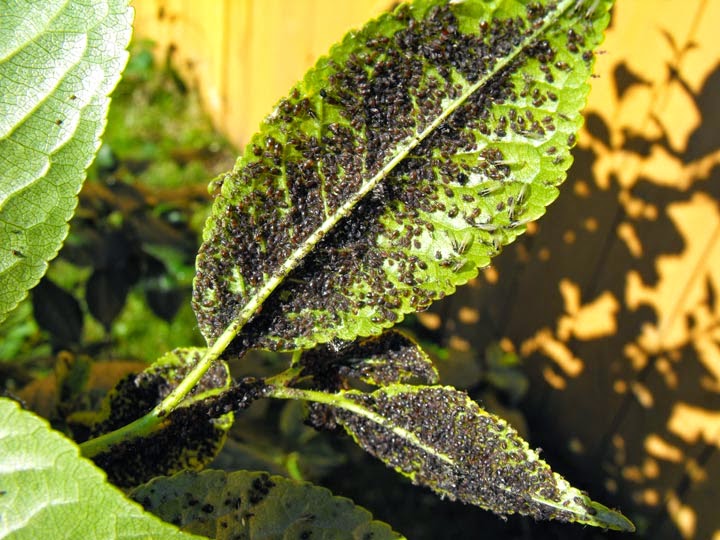
Got up this morning and headed out to weed the garden.  For some reason I looked at one of our 2-year-old cherry trees to see if cherries were visible yet and I saw something bad.  Really bad.  The bottoms of most of the newer leaves were black.  Like dirt had been sprayed up under them.

Upon closer look, I saw that several ladybugs were present on the tree as well as ants.  And a few of the black dirt spots were developing wings - aphids!


I don't like to spray insecticides - they tend to kill of of the bugs, not just the bad ones - the spiders, ladybugs and ants can stay.  But the aphids had to go.

So I got out the best tool I could think of - my fingers.  I went branch by branch and squished as many of the little buggers as I could and then sprayed them off with my hose.  It took an hour and a half to remove the majority of the infestation.  Believe me, I have no illusions that I got rid of them all.


I literally had blood on my hands!  But aside from using insecticides, I couldn't think of what would do as thorough a job.  I just read where garlic is a good companion plant for cherry trees.  Not sure if I can still plant garlic at this late date, but I think I'll try - even if it doesn't produce, it might help keep the pests at bay.

As I went through and got rid of the aphids, I marked each branch with a bread bag tie (being careful not to damage the branches) - it was confusing not knowing which ones I'd done already and this definitely helped.


As an interesting aside, I found 3 ladybugs together - I assume the males were fighting over the female - or there was something kinky going on.


Tuesday, May 27, 2014

Storm Window Greenhouse

Okay, so I've had these old storm windows sitting around for a while, and some of the ones that came off the house this year will not be going back on.  My husband, in his trials to keep things tidier than I do, wanted to take them to the dump, but I insisted we keep them.  I'd love to purge stuff, but there is a saver in me (I won't use the term "hoarder," thank you very much) and an environmentalist who wants to re-use everything.  So they stayed.

Well, today I finally got around to doing something with them.  With nothing but old hardware and such from around the house, I built this:


Be kind - they are old, old windows and it needs a coat of paint, but I'm fairly proud of myself right now.  We'll see if it works!

Tuesday, January 14, 2014

Time to order seeds

For those of you who are thinking of planting a garden this summer, and wanting to get special seeds from special sources, now is the time to sit down with a catalogue or the Internet and do your ordering!

It's really hard to think of such things when there are two feet of snow on the ground and it is currently falling, but it is a nice ritual to sit down and plan out the garden with the hope of spring eventually coming.

I have used the Heritage Harvest Seed Company in the past because they are from Winnipeg and surely, if it grows near Winnipeg, it will grow where I am (and I'm Canadian and it's a Canadian company), but there are lots of great organic providers out there.  A search on the Internet will find someone who has the types of plants you want for the zone in which you live.

You might want to sit down and think of what plants you want and where they are going to go - remember that the tall plants shouldn't block out the smaller ones.  Lettuce needs less sunlight than many other plants.  And Carrots like Tomatoes - the name of a great book about companion planting.

Good luck.

If anyone out there is reading this and lives in my area (Central Alberta), does anyone need help planning their garden?  Or have questions about anything?  I'm not huge expert, but I've been doing it for a few years and would really like to encourage people to grow their own food.

Wednesday, October 2, 2013

Tomatoes!!!!!

As I mentioned on my other blog (Renaissance Woman) yesterday, I've been feeling rather lackadaisical lately.  I think I've been busy with a lot of things, uninspired and just feeling like the world was rushing past at an alarming rate (still am feeling that, actually), so I just haven't felt inspired to blog.  I barely felt inspired to garden, which is strange for me.

This year, instead of planting the upwards of 100 tomato plants that I've done in the past, I planted about 40.  I paid very little attention to them, sprayed with copper spray (which helps prevent blight) only 2 or 3 times all summer when I should have probably been doing it every 10 days or two weeks, and only trimmed the plants occasionally.  I really let the garden do it's own thing - with the exception of a few concentrated days of weeding mid-summer.  I didn't water very often because we had some rain and I just wasn't into it.  And when I did water, I'm ashamed to say I didn't take it out of the rain barrel, but used the sprinkler.

By all accounts, I should have had overgrown plants with very few tomatoes, blossom end rot and blight.  They were kind of overgrown, but no blossom end rot (which is caused by inconsistent watering) at all and very little blight (a few, but so far, not too bad.  I could still end up with a lot of blight - a couple of years ago most of my tomato crop to blight after they were all picked.  I estimated about 200 pounds worth.  So I'm not counting that out yet, but I do have a few tomatoes to deal with:


I'm thinking I'll have to make tomato sauce this year - and maybe green tomato pickles (although I really don't enjoy eating pickled things at all).  I've already canned about 30 jars of just tomatoes!

Any other suggestions?

We also got lots of potatoes, carrots and onions this year.  Not so many peas.  Maybe I'll blog about that one next.

Tuesday, June 25, 2013

Climate Change and why we should all garden!

This blog is not intended to be a political soapbox.  And this post is not intended to be political, although some people might think it is.

First off, the topic of climate change should not be political, although it seems to have become one (and I use the term "climate change" on purpose here, as opposed to "global warming", only because in some places on the planet, we are seeing a cooling instead of a warming - although the planetary mean temperature is going up, some people use colder than normal temperatures to argue against "global warming" and I don't want to be part of that silly discussion).  In my mind it isn't a matter of the "climate change supporters" opposing the "climate change deniers".  It is a simple fact that our weather is changing and becoming less predictable.  I don't think at this point that we're in the "we can't survive it" stage.  It's just more severe than it used to be.

In 2005, I lived in Calgary when we experienced the worst storm my husband had ever seen (I'm not sure I can say that since I did see a storm that spawned 20 tornadoes when I lived in Texas, but the Calgary storm was pretty nasty).  It produced what was called a "once in a hundred years" flood - many basements were flooded and the moose had to be relocated from the zoo.  Then we moved away closer to Edmonton, about 2.5 hours north.  Four summers ago the stage at the Big Valley Jamboree was torn down and one person died under it, in a storm that also saw my family huddling in the basement and a large tree land on our garage.  Two summers ago, in Millet, Alberta, (10 minutes north of us) I saw the results of a hail storm that left gardens in tatters and vinyl siding looking like the victim of a 1930s Tommygun attack.  And this past week we've all been watching in awe as Mother Nature left Southern Alberta struggling to come to terms with more water than they've ever experienced before - ALL of the animals at the zoo had to be moved and I think 75,000 people moved from their homes in Calgary alone (not to minimize it, of course, a whole lot more horrible things happened, but you can Google it - let's just say it was many times worse than 2005).  A mere 8 years after the "once in a hundred years" flood, we suddenly had a "worse than ever recorded" flood.

Climate Change is not a political subject, my friends, it is a reality.  It IS happening, whether we like it or not, and denying it's existence will not help fix it, nor will it help us deal with the consequences.

So here's where I think we can all do a little bit to secure ourselves.  If these massive weather events continue to occur, our food safety will be in jeopardy - I'd say it's already tenuous.  We will not necessarily be able to get corn from Iowa if there are droughts there.  We will not necessarily be able to get wheat from Alberta if there are massive floods.  We will not necessarily be able to get oranges from Florida if they have frost.  We need to be able to at least partially feed ourselves.

WE NEED TO GARDEN!

And we don't just need to garden so that we can sustain ourselves next winter if the power goes out and we can't get groceries for a few days.  We need to learn how to garden (and teach our children how to do so) so that if our infrastructure collapses significantly, it's become a part of our daily lives to sustain ourselves.  We are a the whim of a very large, complex transportation and economic system that is very vulnerable to major weather events - and we are having them.  Frequently.  We really need to take more responsibility for our own day to day needs so that we are not left suffering when our regular way of life isn't working anymore.

And we need to grow more food than we need - so that when our neighbours are dealing with a catastrophic event, we can help feed them.  And vice versa.  If my garden is decimated by a hail storm, I'm hoping someone a few miles away can share their food with me.  I really am hoping that.  Please share!  I'd rather have to end up composting some of my bounty because no one needed it, than not have any to give to those in need.

I'd lost perspective on all of that this year.  I haven't been as passionate about my garden - or about not using plastics, or about recycling and reducing.  But the Calgary floods brought it all back into perspective.  Although it's hard work, and sometimes it feels like everything is just ticking along status quo and the hard work isn't worth it, major disasters remind me that things are indeed changing.  That urgency I've felt to adjust my life and to get a better handle on our self-sustainability wasn't just a whim.  It's real and I need to get back to it.  Time to get back to taking care of my people and the Earth.

Thursday, May 16, 2013

Late Start

Well, it's been a late start to the garden this year.  Our weather was crazy and we seemed to have gone directly from winter to summer in the matter of 2 weeks.  One year I remember planting some of my peas as early as mid-April (which, believe-you-me, is early for around here).  But this year I only got them planted on Monday (May 13).  A few peas were growing on their own, so I re-positioned them and have a few plants that are 4 or 5 inches tall at this point.  I also had 3 carrots survive in the ground over the winter (thought I got them all, but there's always a couple), so they are now in pots and I will try to get seed from them like I did with my lone second-season carrot last summer.  You see, carrots have a 2-year life cycle and only go to seed in the second year.  More information on carrots can be found at the carrot museum!  And there are about 6 onions I missed last year, too.  They are all sprouting.

I've gotten most of my plot weeded, although there is still a lot left to do.  And I did manage to plant a couple of potatoes that had very long "eyes" as well as the garlic.  So today I will go out, continue weeding, maybe thin out my raspberries, and possibly plant some lettuce.  Spinach should be planted now, too, BTW.  Although if it's too hot, neither will do terribly well.  We might have missed the lettuce/spinach window, but no harm in trying.

As a lot of you know from FB, I have extra tomato plants if anyone in my area is interested.  Most of them are heirloom, but not all.  I'll be most likely planting mine on Sunday as it seems any threat of frost is past (famous last words).  Of course, if frost does come back, we cover all our plants with old sheets, buckets and towels.  Never throw them out, they come in handy in early and late summer when frost threatens our little crops.

I'm going to be slightly less ambitious with my garden this year.  Every year I just pack the soil and the garden ends up like a jungle by the end of the summer.  This year the plan is to stick to the plants we really utilize, and not to crowd everyone.  To that end, I've planted my pumpkins in a separate area by our fence - not technically a garden, but I guess it is now.

Hope you all have a chance to go out there and get dirty.  My toenails won't be clean again until fall - so don't look at them!

Thursday, April 18, 2013

Mice in the Compost

New garden-related problem - I seem to have a mouse nest in my compost pile.

My first clue was that the cat has been hanging around the compost for the past month or so - whenever it has been warm enough to be outside.  And she's been super interested in what's going on in it - she looks like a vulture staring down into the compost.  Remember Snoopy when he looked like a vulture?  Well, that's Jack.


The good news - I have a cat who is a mouser - she's gnawing on one in the back yard right now. 

The bad news - I have to turn that compost pretty soon and I'm not looking forward to disturbing mice while I do it.

So research is needed. 

I'll keep you posted on what I find, but upon initial perusal, it looks like I need to do more maintenance than I have been.  Turning the compost is vital.  But the problem is that the compost bin we have is so large that I have a hard time actually turning it.  It is really hard work.  But I guess I just have to put aside several hours (when it's warm enough) and turn it a couple of times per year.  Maybe buying a barrel composter would help.

The other thing is that I occasionally add meat to the compost - apparently a no no.  As is adding baked goods which I often do.  These things attract vermin.  And let's face it, vermin aren't good to have near food.  There's Hanta virus, not to mention the Plague - both transmitted by small rodents. 

1/4 inch mesh lining the bottom and the sides would be good, too.  And putting newspapers and boards across the top as a cover might help.  They say to always have a cover, but my compost bins are large wooden slat numbers, and a real cover would be cumbersome.

I think my best solution to this problem is the cat.  She's good at what she does.  And instead of getting upset when she kills something, I should be grateful.  Because she is doing her job!

Monday, March 18, 2013

Plants? In the greenhouse.

My first year gardening in Alberta, I thought I'd start my own tomato seeds.  It was a pathetic mess.  They got lanky and fell over and were generally not usable.  So the next year I bought a small greenhouse at the local hardware store and set it up in one of our tall south-facing windows.  It works like a charm.  I start all my seeds in it and they thrive in there.

As do other things.  The first thing to sprout every year is fuzzy ....


Our cat, Jack.  Enjoying the warmth and sunshine in the greenhouse.

I also have some pumpkins sitting in our basement.  My plan was to cut them up and can them - but they are a little past their prime, so last week I cut one open to get the seeds.  Several of them were germinating in the pumpkin, so I planted them.  It's early for squash.  I think you want to go more like 3-4 weeks before the last frost - we're more like 10 weeks out, but they were ready to go.  I'll have big plants when they are ready to put into the ground. 

I also started basil today.

Winter! And tomatoes.

Hello everyone!

I've decided to split off my gardening/urban farming posts from Renaissance Woman and create a separate blog for them.  So welcome to Northern Urban Farming! 

I'm wondering if "farming" is a good word for it.  I don't actually farm.  I don't raise chickens or rabbits.  But someday I might.  And since Urban Farming is a good catch phrase, I'll stick with it.

For anyone new to my blogs or unfamiliar with where I live, I'll just give you some relevant info.  I live in a small town (about 12,000 - which, if you think of it, several hundred years ago would have been considered an urban centre) in Central Alberta, Canada.  It is March 18, 2013 and this morning it was -19C when I woke up.  This is not typical weather for March.  But, then, at any time of the year you can hear anyone say that it isn't typical weather.  We have unpredictable weather here.  The forecast for less than 2 weeks from now is for +10C every day.

Gardening here sounds like it is a challenge - and I suppose it can be.  But since I never seriously gardened anywhere else, it just seems normal to me.

I hope I can share useful information here for other people trying to garden in colder climates.  I'm just about sharing information, so if you have something useful and practical to add in comments, I welcome them.

As I stare out the window at all that snow, it's hard to think about growing food out there in the garden.  But it is actually time to think about planting.  Yesterday I planted tomato seeds for the summer.  I usually plant between 125 and 150 seeds thinking some won't start.  Usually they all do - but some don't start soon enough and the plants will never produce tomatoes.  So start more than you need.  But early to mid-March is the time.  Don't start them any earlier.  They won't mature earlier, somehow they all seem to produce at the same time anyhow, no matter when you start them.  But later than mid-March and they probably won't. 

You need a VERY sunny spot to start tomatoes.  Anywhere without enough sun and your plants will get long and lanky and will never survive or stand on their own.  So warm and sunny.  Later, when it is warm enough to take them outside (10C or above), I'll try to remember to tell you how to ease them into it.  Indoor sun is different from outdoor sun and you have to let them get used to it.  Imagine throwing yourself outside all pale and sensitive from being inside all winter - you'd get sunburned!  Well, I've had a lot of sunburned plants over the years from leaving them out too long too soon.  But getting them outside early is important.  The more wind and movement they get as young plants, the stronger they will be as mature ones.